

Today, I want to talk about another stock that I’m researching.
It’s been sitting in my serial acquirer database for some time.
This company is run by a management team from another successful serial acquirer that increased the market cap 10x in 10 years.
The company is called Berner Industrier.
Let’s dive in ⬇️
A short introduction
A family-controlled Swedish industrial group, founded in 1897 and listed on Nasdaq Stockholm (BERNER), with ten Nordic subsidiaries that make and distribute pumps, electric boilers, water treatment, and other industrial equipment. It is an early-stage serial acquirer coming out of a turnaround. “Berner 2.0” began in 2022 with a new management team, with Caroline Reuterskiöld at the helm. She previously ran a division at Lagercrantz, arguably the most accomplished serial acquirer in the Nordics.
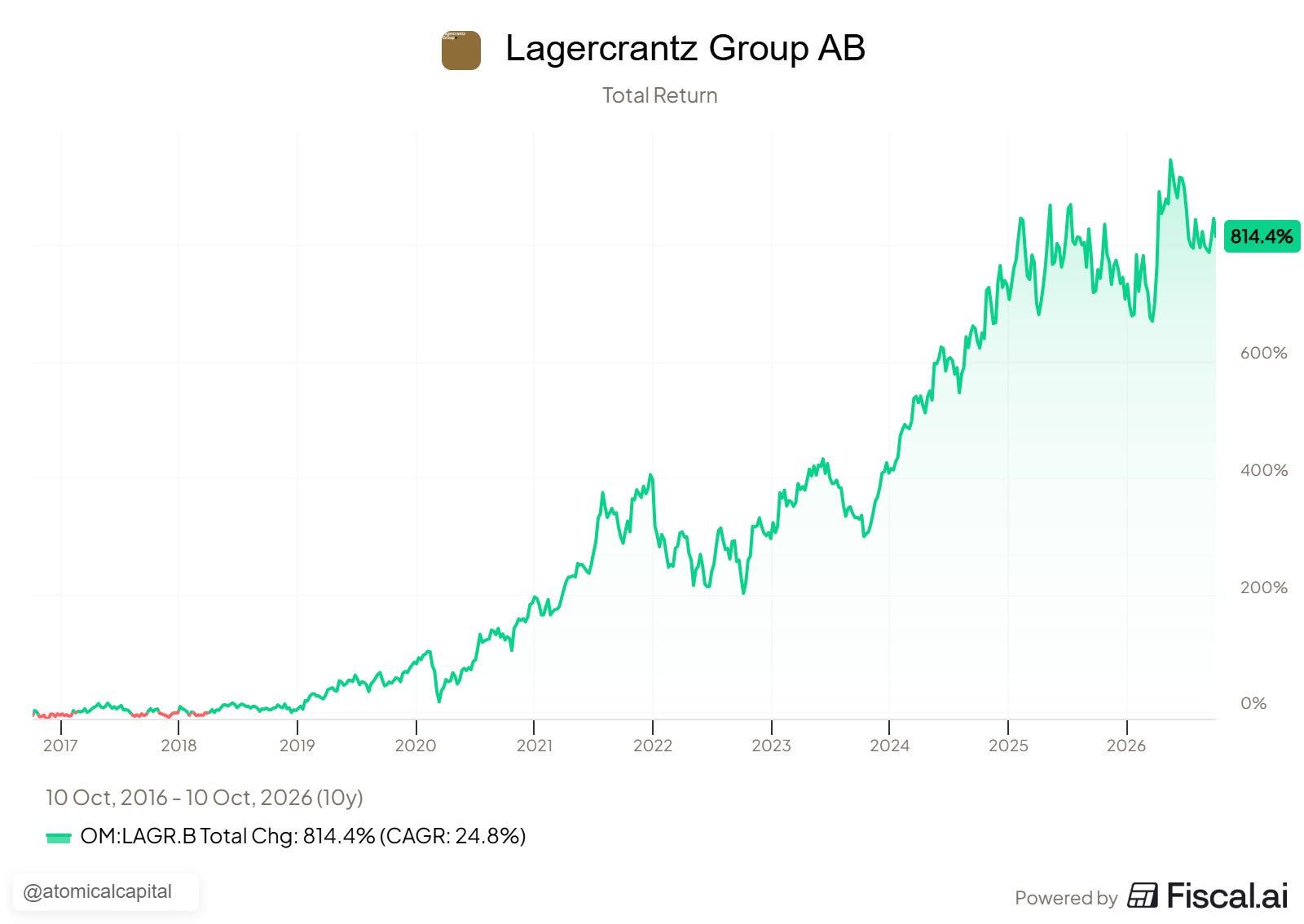
Lagercrantz’s returns aren’t too bad 😉, with an almost 25% CAGR over the last 10 years.
Pricing:
Market Cap: 1.5B SEK (€133M)
Net debt ex IFRS 16: 125.1M SEK
Net debt incl. IFRS 16: 200.5M SEK
LTM EV (ex IFRS16)/EBITA: 15x
LTM PE: 18x
Management’s future guidance:
Net sales growth of at least 10% per year on average over a cycle
EBITA growth of at least 15% a year on average over a cycle
Return on equity of at least 25%
Net debt/LTM EBITDA below 2.5x
The moat: They have 2 segments. The moat is high for Energy & Environment, which owns its products and holds niche, IP-protected positions in electric boilers, dampers, screw presses, and patented low-shear technology. But the moat is weaker for the distribution segment, which relies on long supplier relationships and industry expertise as its core advantages.
The bet: A management team that repaired the old business (EBITA from SEK 31m in 2021 to SEK 100m in 2025) now compounds through acquisitions.
The problem: like most Nordic industrial serial acquirers, the acquired companies grow only 5% organically, so the upside depends on future and continued M&A. The first deal under the new CEO closed in 2025, leaving a short track record at Berner, though her Lagercrantz track record is strong. A further, more short-term issue is weak order intake over the past two quarters.
Potential outcome: The outcome is straightforward. If management deploys capital into good businesses at high ROIC and hits its target of at least 15% average EBITA growth over a cycle, Berner looks like an early version of the Swedish compounders, with a long runway and a potential IRR of +20%. If not, it is a 5% grower on 18x earnings, and the multiple could derate.
What to watch: organic growth, sensible acquisitions and EBITA growing faster than revenue.
A deeper look into the business
Berner Industrier started in Gothenburg in 1897 as Christian Berner, an importer of technical equipment for breweries. Norwegian, Finnish and Danish subsidiaries followed between 1910 and 1924, and for most of its history it was a Nordic technical trading house. It was listed as Christian Berner Tech Trade in 2014 and renamed itself Berner Industrier in May 2024.
A capital raise around the 2017 uplisting funded the first standalone acquisitions: Zander & Ingeström (2018), Empakk and Alfa Tec (2019), Bullerbekämparen (2020) and Swedenborg (2021). In 2022, the new management team arrived, split the group into two decentralized business areas, and spent three years fixing margins and cash generation. Acquisitions restarted with Autofric (May 2025), Typhonix (January 2026), and Jernbro Water Technologies, a small asset deal added to Autofric (March 2026). All of these deals targeted the higher-quality Energy & Environment segment.
What are you actually buying?
Two very different businesses under one roof:
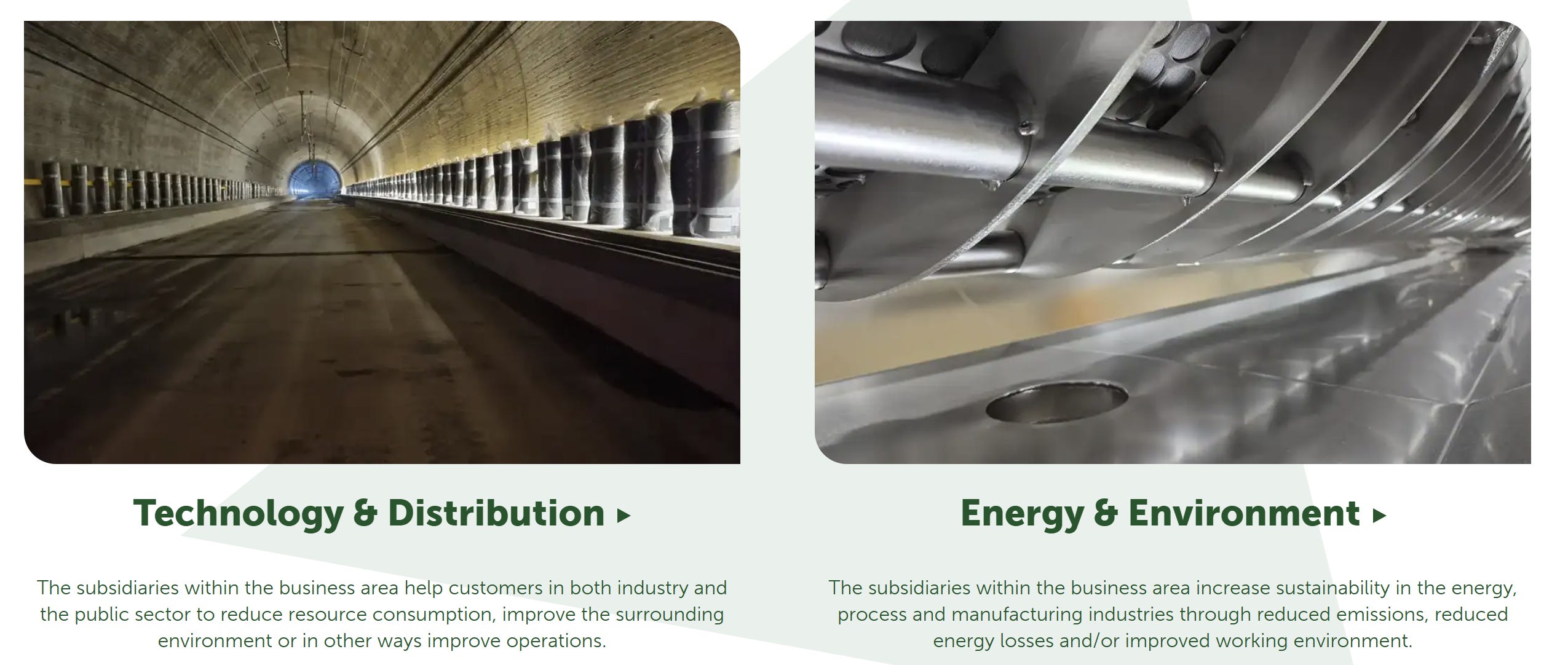
a low-margin distributor
a higher-margin cluster of own-product companies.
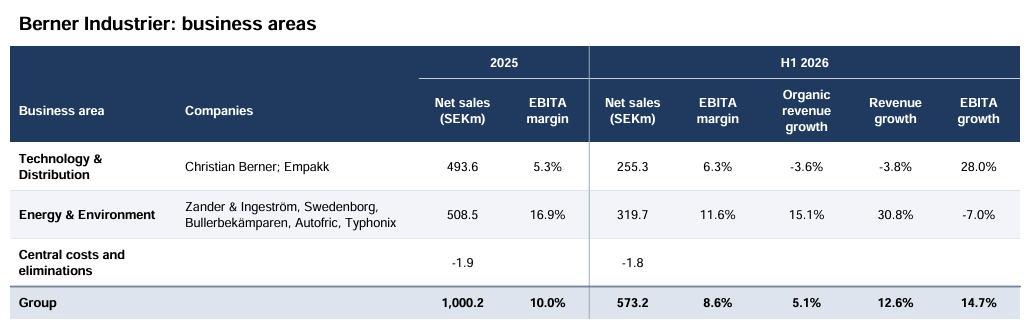
Technology & Distribution is the heritage business. The four Christian Berner companies sell other makers’ products in water treatment, vibration damping, packaging, process technology, and technical plastics, mostly in their home markets and partly on commission. Empakk in Norway (packaging and processing equipment) has been the business area’s best performer in 2025 and 2026. The margin was 1.3% in 2024 and 5.3% in 2025, after cost cuts and pruning of low-margin lines.
Energy & Environment is where the earnings are. It produced about three-quarters of segment EBITA in 2025. These companies make or own their products and sell across the Nordics and abroad: Zander & Ingeström, bought in 2018, is the main engine of the business area. It makes Zeta electric boilers that replace oil, coal and gas boilers, as well as high-pressure and process pumps. The rest of the business segment consists of: industrial dampers (Swedenborg), noise-reducing control cabins (Bullerbekämparen), Autofric screw presses for sludge dewatering, and Typhonix low-shear pumps and valves for produced water.
Where will growth come from?
Acquisitions
Berner looks for niche businesses, usually with specialist technology or a strong position in a small market, and lets them run in a decentralized way. The model is not unique: Lifco, Addtech, Indutrade and Lagercrantz have run variations of it for decades. What makes Berner interesting is its size. It gives the company a long runway, provided management stays disciplined, as it has so far.
So what about the last 3 acquisitions?
Autofric: sludge dewatering, closed May 2025, for SEK 55M
Typhonix: low shear pumps and valves, closed January 2026, for SEK 55M
Jernbro Water Technologies: add-on to Autofric, March 2026, small & no price disclosed
Headroom to keep buying. The balance sheet supports that runway. Net debt is 0.9x LTM EBITDA against a ceiling of 2.5x, which leaves considerable room for acquisitions. In addition, more than 70% of net income should convert into free cash flow, which adds further headroom.
Competition for good deals: Berner competes mainly with Lifco, Addtech, Indutrade, Lagercrantz, Teqnion and private equity, all with far longer track records. Its advantage is size. A company with SEK15 to SEK60m of revenue moves Berner’s earnings, while larger buyers need many such deals to matter and so target bigger ones. The CEO’s track record, network and expertise from Lagercrantz also help a lot.
Organic growth
Over a full cycle, I think the businesses can grow organically at 5 to 10% a year. Where they land depends on three things.
End-market demand: spending on water treatment, electrification of industrial heat, and resource efficiency, which drives Energy & Environment.
International Expansion: How far are the subsidiaries able to take their own products beyond the Nordics, as Zander & Ingeström has started to do with a new partner in France and the Benelux, and Typhonix with its first order in Asia.
Industrial customers’ willingness to invest. That has been cautious since 2025 and weighs most on the distribution business.
The water tailwind. Berner’s current M&A focus is water, which is also the most attractive exposure in the group. Its two latest acquisitions show this. Autofric sells sludge-dewatering equipment, and Typhonix has patented technology for produced water treatment. Both tie Berner to long-term spending on cleaner water, resource efficiency and industrial infrastructure, without heroic assumptions about a new technology taking off. Water scarcity already affects billions of people and will only get worse.
Management and ownership
Berner 2.0. Caroline Reuterskiöld became CEO on April 28, 2022. She came from Lagercrantz, one of Sweden’s most accomplished serial acquirers, where, as division CEO, she ran Niche Products and oversaw many acquisitions in the same areas where Berner is active. Investors and industry experts I have spoken to consistently praise her grasp of the business as a whole and her sense for capital allocation, as one would expect from a former Lagercrantz division head. Henrik Nordin, CFO and deputy CEO, joined later in the same year from Infrea.
Together they reset Berner into the classic Swedish programmatic acquirer mold, introducing its typical best practices and a decentralized management structure.
Decentralized, but with new operators. Eight of the nine subsidiary directors listed in the 2025 annual report took their role in 2022 or later. In other words, they brought in fresh blood to drive performance.
Alignment. The CEO owns 173,875 shares, worth 2.4x her 2025 pay of SEK 5.3m. The CFO owns 38,000 shares. Both hold 50,000 warrants from the 2025/28 program, which they bought at market value; the warrants are struck at SEK 115, 40% above today’s price, and can be exercised in November 2028.
➡️So the incentives look aligned.
Family control. Gårdaverken, chaired by Joachim Berner, owns 22% of the capital and 51% of the votes through all 1,250,000 A shares (ten votes each). Gårdaverken’s CEO, Pim Polesie, also sits on the board. Two further holders carrying the Berner name own another 11.9%.
Capital returns. The policy is to pay out 30% to 50% of profit after tax, taking acquisitions, cash flow and financial position into account. The 2025 dividend was SEK 1.25 per share (SEK 0.95 the year before), SEK 23.8m in total, about 33% of 2025 profit. In September 2026, the company also bought back 275,000 shares for SEK 19.9m (average SEK 72.30) and holds them in treasury; the AGM authorization allows up to 10%.
As I understand it, however, the buyback is meant to fund acquisitions without dilution rather than to return cash to shareholders.
Explanation of the recent price drop
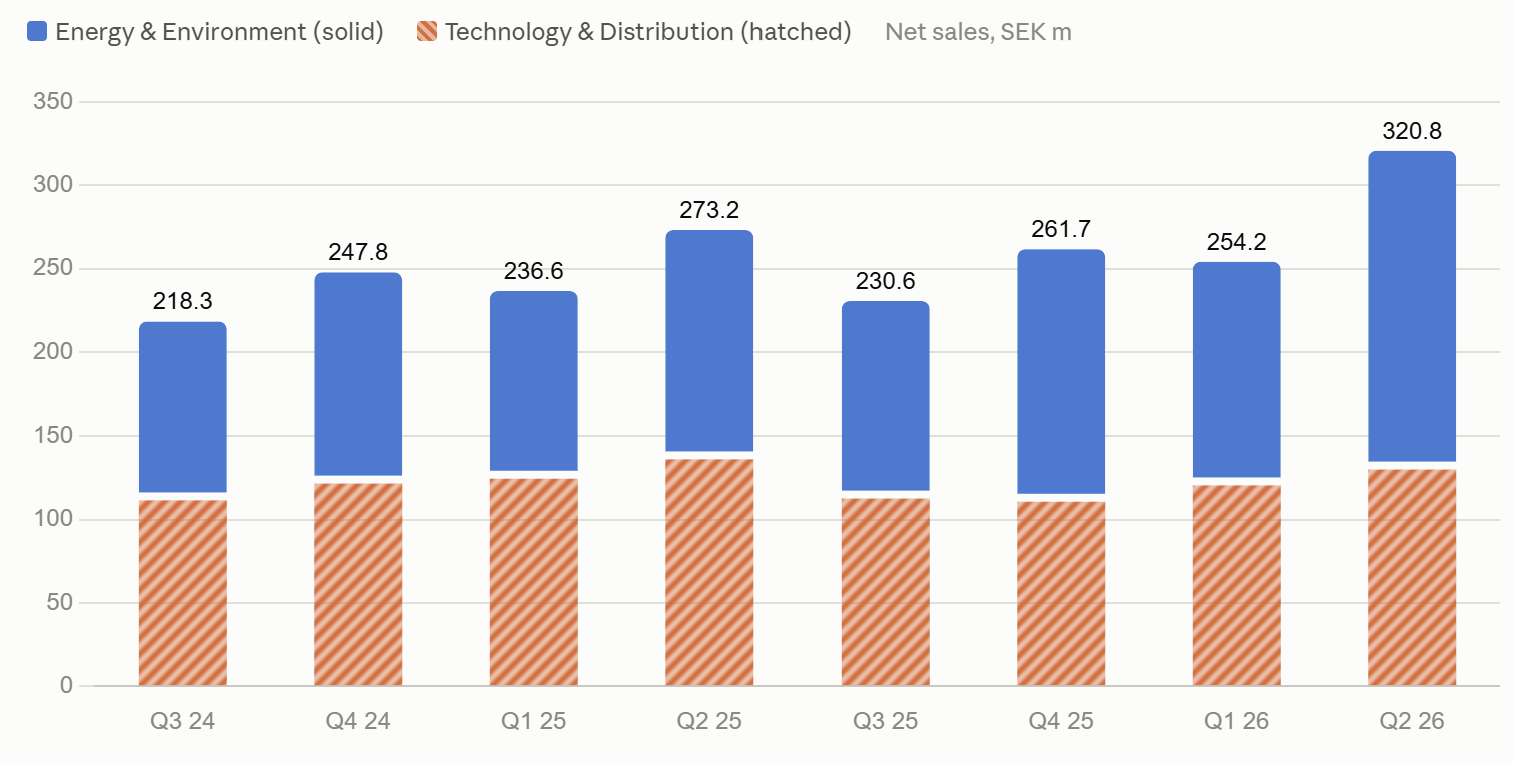
In February 2026, Berner reiterated its 10% annual sales growth target. Having already passed its 9% EBITA margin target (10% in 2025), it swapped that goal for average EBITA growth of at least 15% a year across a cycle, a major guidance upgrade. Since then, order intake has made the sales target, and therefore the EBITA target, hard to justify, with growth of only 5% in Q1 and 1.8% in Q2, and shares have fallen from SEK 115 to SEK 80.
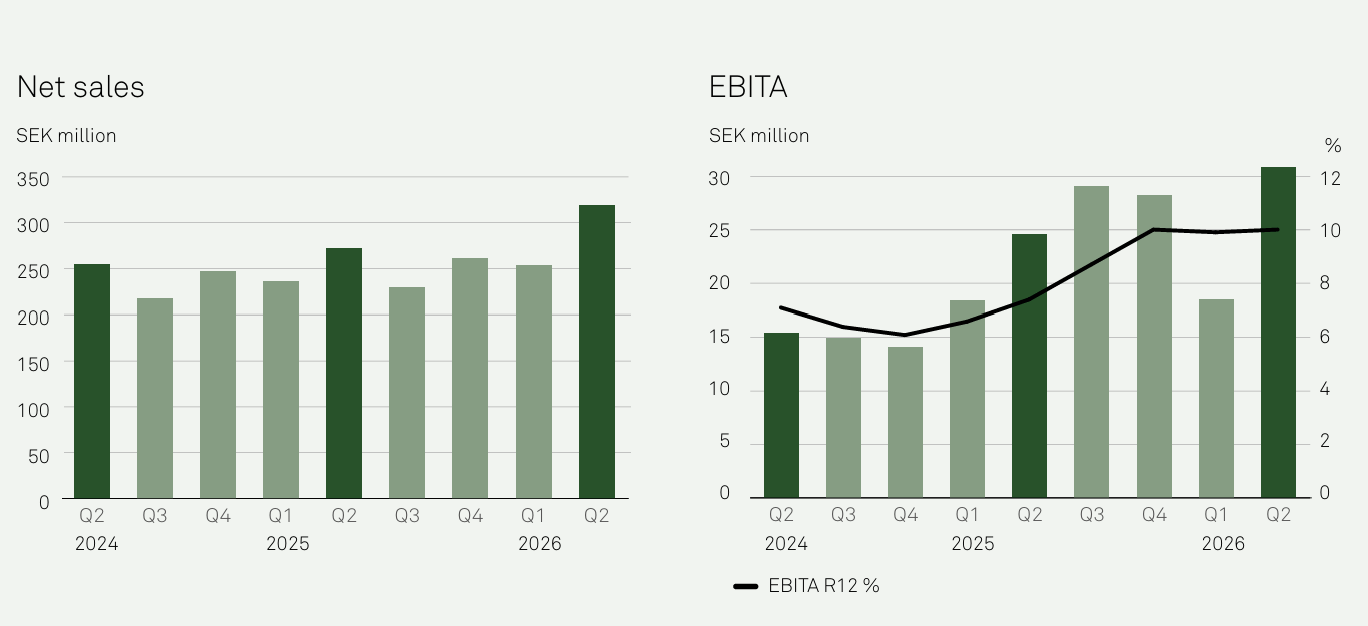
Management points to the natural lumpiness of the business and expects H2 order intake to be meaningfully higher, but for now this gap between orders and sales is the main reason the shares have fallen.
Based on past numbers and the recent acquisitions, management is clearly focusing on growing the higher-margin part of the business (Energy and Environment). But, for example, the electric boiler sales create lumpiness in the numbers. Their more recent acquisitions have a steadier revenue flow. If they keep acquiring similar businesses, future revenue and earnings will be more predictable. In the meantime, it could offer a more compelling entry point into this business.
Here are the revenue and EBITA charts for each segment:
And for EBITA
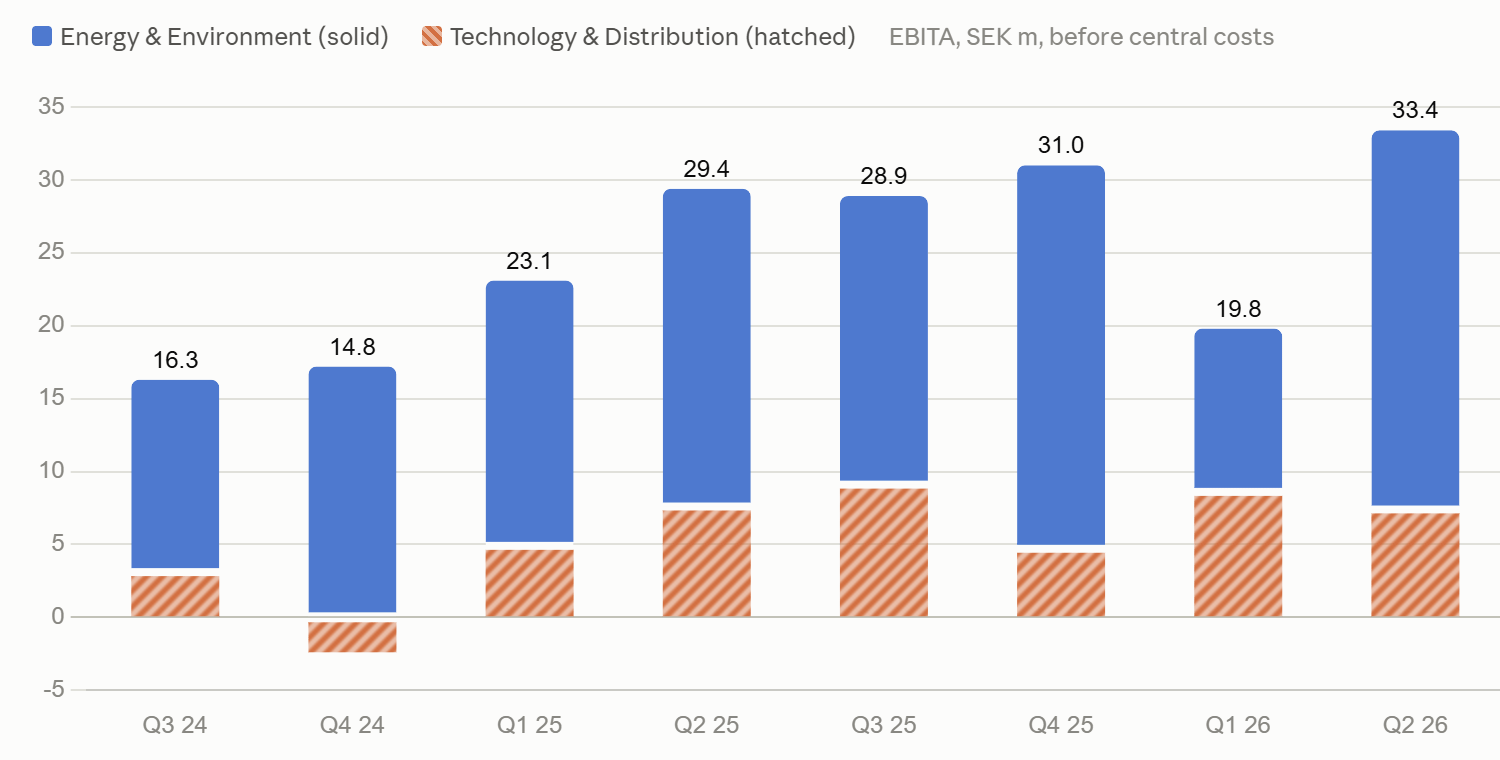
This last one is especially telling. Management should focus on growing the blue part, which drives most of the profitability.
Finally, a quick look at past EV/EBIT (for Berner, EBITA is close to EBIT)
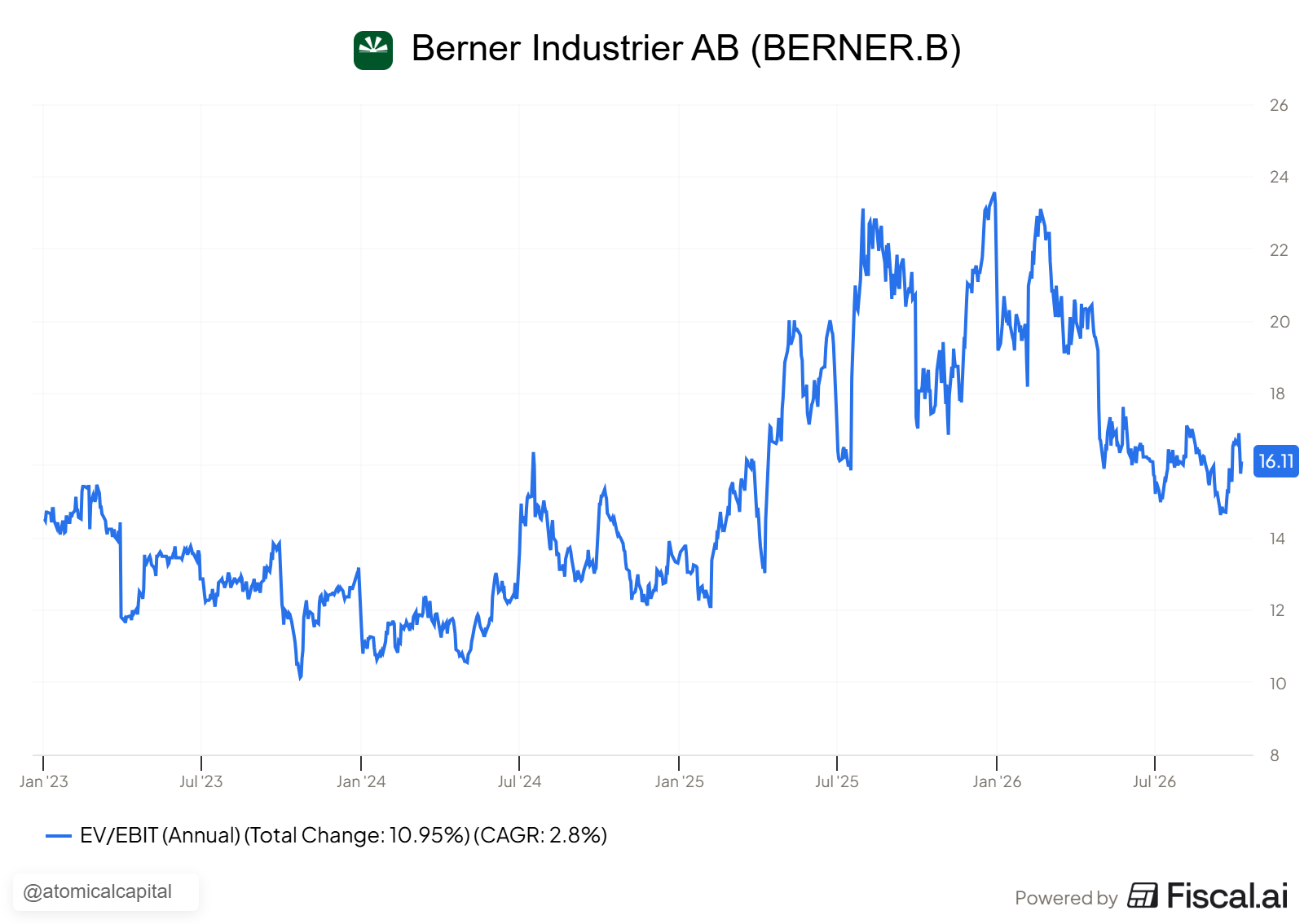
So it has come down quite a bit from the highs this year.
Risks
Unproven deal discipline. The thesis rests on M&A, but management has completed only three deals and has no public track record.
Family control. Gårdaverken holds 51% of the votes, two of six directors depend on the main owner, and the payout preference is the family’s. That brings patience, but minorities have no say on a sale or on capital returns.
Key people. With a two-person head office, the CEO and CFO drive acquisitions. Losing either would hurt.
Order Intake. Orders are lagging sales, as discussed above. If the H2 pickup doesn’t materialize, the market will react strongly.
Current status
There is something here: a cleaned-up group, real niche products in energy and water, a lean head office, low leverage, and a management team with the right pedigree and incentives. What is not yet proven is the part that makes a serial acquirer worth owning: buying well, repeatedly, and making acquired companies earn more under Berner than they did before. The early signs are encouraging. The CEO built a strong track record at Lagercrantz, and so far every acquisition is developing as planned.
The thesis comes down to whether the new Management can deploy capital at a high, sustained ROIC and whether order intake recovers. Both rest on one thing: do you trust management and its ability to deliver?
Decision:
More research needed. Tracking the company. The next disclosure of their interim results will be on November 3rd. The beauty of a serial acquirer like this is that we don’t have to rush. Let’s first see if the recovery the CEO pointed at materializes. Even if the price moves up based on the November results, we are aiming for a serial acquirer with a working engine.
I will write about more companies in the pipeline soon.
May the markets be with you, always!
Kevin