

1. The bubble meter
Here’s the most recent version of the bubble meter:

One thing that turned towards an all time high is the margin debt.
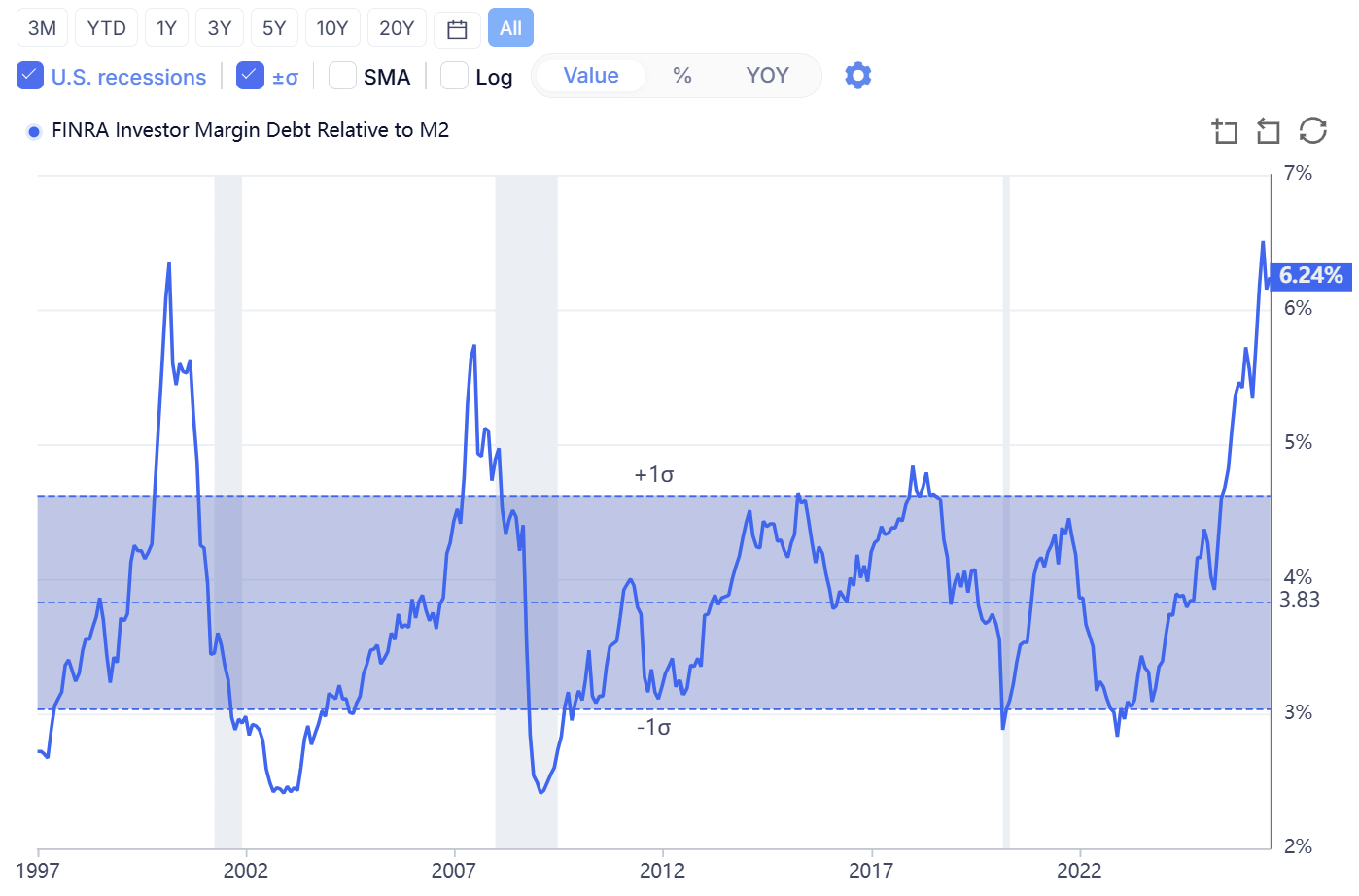
The vertical grey lines are the past recessions.
While margin debt doesn’t predict a future recession, it does show investors are taking on more risk.
Yesterday, I had the honor of being on a debate panel in front of 500 investors.

It was a full house!
One question was: How do you position yourself with rising interest rates?
Using Claude, I analyze my portfolio for interest-rate exposure. But most of our companies have solid balance sheets.
We cannot control the macro. I try not to spend too much time on it. We can control the quality of the companies we pick.
That brings me to this week’s idea.
2. Stu(o)ck in the funnel
Intred (ITD.MI)
The setup in short
What: Regional fiber operator in Lombardy, Italy. Owns 15,000 km of its own network, serves 57k customers, mostly SMEs, town halls, and schools
Valuation: €140M market cap, €180M EV, 7.0x EV/EBITDA today, 4.8x on 2029e
Balance sheet: €41M net debt, 1.6x EBITDA. Not stretched, but not empty either
The moat: Nobody builds a second network into a village of 3,000 people. The replacement cost of what Intred owns is €200M
The bet: Capex normalizes after the data center is finished, and the cash finally shows up at the shareholder level
The problem: That happens in 2029. FCF is negative in 2027 and thin in 2028
Outcome: Not binary. Slow, boring, and probably positive.
My stance: Interesting enough to do the real work on
Description: Intred (Ticker: ITD.MI) is a vertically integrated telecom operator in Lombardy. It sells fiber connectivity, and it owns the fiber it sells. Revenue splits into B2B/professional (56%), residential (18%), public administration (17%), and wholesale (9%). While the consumer brand is what people see, 85% of profits come from B2B, public, and wholesale.
This is an infrastructure business.
FY25: €55.8M revenue, €25.5M EBITDA, a 45.8% margin. About 96% of revenue is recurring or prepaid, and churn was only 4.4%. Founder Daniele Peli controls 60% of the stock.
Type: Profitable, owner-operated, illiquid infrastructure microcap
Why it’s interesting: A local monopoly you can buy at 5x forward EBITDA, with a founder who already declined a takeover offer of twice the current price.
The rundown: The economics of fiber are simple. You spend an enormous amount of money once, digging ditches. After that, connecting a new customer near an existing cable costs little. In the small Lombardy towns, Intred got there first, and it is the only one there. A second builder would have to earn a return on €200M of replacement cost while Intred, already paid off, undercuts him at will. So nobody comes.
B2B and public administration deals run three to five years with automatic renewal. ARPU went from €700 in FY15 to €1,050 in FY24, in a national market where telecom pricing only goes down. Not through price hikes, but through speed upgrades, bundles, and managed services. And OpenFiber, the state wholesale layer, does not chase bespoke B2B connections, which is exactly the segment carrying the profits.
An important accelerator for Intred was the €60M Infratel contract in 2021, which put them into every school and town hall in Lombardy. Once your cable is in the town hall, the next tender in that town is cheaper for you to win than for anyone else.
The problem: Capex runs roughly in line with EBITDA for the next couple of years. FY27 is the peak data center investment year, which is being built as a further cross-selling point. FCF is negative in 2027, thin in 2028, and distributable cash arrives around 2029.
Management guides to capex normalizing and a shift from expansion to utilization, which would push ROIC from 10% toward 15%.
I find that credible.
Ownership: Peli holds 60% of shares, is chairman and CEO, is deeply involved, and there is no succession plan. Italian public tenders and heavy capex carry integrity risk.
Current status: Warrants deeper due diligence.
At €8.8, the shares trade at roughly 6.7x FY26e EV/EBITDA and about 10x normalized FY26e free cash flow. As EBITDA moves toward €37M by FY29e, those multiples compress to about 5x and 7x respectively. On top of that, the company has spent roughly €200M building its network, or €12.5 per share. Well-run fiber operators such as Intred typically trade near 3x replacement value, which for a network this recent should sit close to build cost.
The founder reportedly turned down €18/share in early 2025, and said he’d think about it closer to €30.
Either he’s stubborn, or the market is asleep.
3. Best article of the week
A great article I’ve read recently by Dean over at Petty Cash called

Filtering Ideas: Learning to Say No
Not everything deserves your time. Most ideas don’t fail because they’re bad. They never get the time or attention required to become actionable…
It’s about saying no.
Dean tells a story from before he was a full-time investor, when he first became a manager. Thirty-plus direct reports, overdue reviews, safety audits, other departments waiting on him, a family, and an investing education he was trying to squeeze into the cracks. He laid it all out for his boss, hoping for a solution.
Her answer: you will need to pick who you disappoint. It’s part of your job.
Not “prioritize better.” Not “delegate more.”
Pick who you disappoint.
Most advice about focus is about cutting the things you don’t want to do. That’s the easy version. Anybody can drop the boring meeting. The hard version is that with limited time, you also say no to things you genuinely want to do.
Which is exactly what research feels like.
You have more ideas than hours. Every hour spent understanding one company is an hour not spent on another. So you abandon an interesting name at 70% complete, because you already know you’re not going to take it the last 30%. You pass on something with a couple of yellow flags, and three months later it triples while everyone on X takes a victory lap.
Being disciplined means you will sometimes look stupid. Get used to it.
What can we learn from this:
Your filter is your edge. Not your analysis. Anyone can analyze; almost nobody says no.
Reframe the question from “what should I do?” to “what am I choosing not to do?”
Not having an opinion is a legitimate position. “I have no idea what will happen” is often the most honest answer available.
The cost of saying no is social, and it’s real. Pay it anyway.
Also, we’re all guilty of mindlessly saying yes. Including me.
May the markets be with you, always!
Kevin